Tag: birding

  • Face to Face with My Feathered Neighbours

    Face to Face with My Feathered Neighbours

    I envy the birds. And the dogs, and the cats. They don’t have to go to school or to the office. Their purpose is simple: find food, try not to become someone else’s food, and spend the rest of the day roaming around or sleeping. To me they seem “free” in true sense.

    They don’t have the safety of a fixed meal or a roof over their heads. But even with all of that are we really free? We all waste time and energy chasing the “value” no one needs at the end.

    Maybe that is why I like watching them. They show me what life looks like, to simply exist and do nothing (most of the time).

    A flat chosen for its window

    When we were house-hunting, there were many reasons to pick a flat: the usual necessities and a basic upgrade.

    This time for me along with the basic necessities one thing stood out , a big window. And it facing 2 trees and the Mula-Mutha riverbanks in the background.
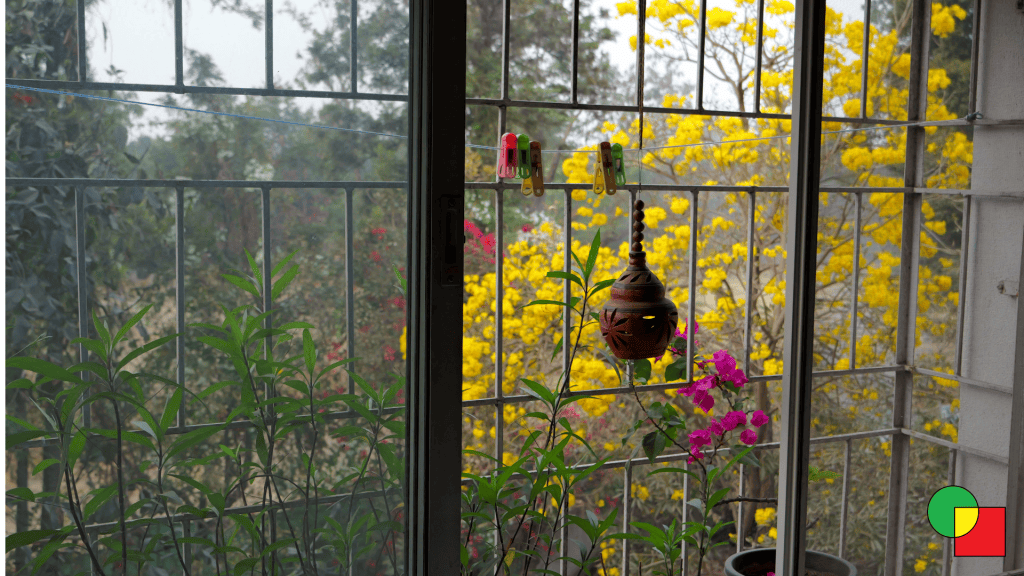
    Two trees seen from a bedroom window, with the Mula-Mutha riverbanks beyond.
    The view from the bedroom window

    The trees had a set of birds and chirps were so soothing when we visited for the first time. It stood out from the cacophony of city traffic.

    We lived there for about 2 years. We spent a lot of that time at the window, looking out at our feathered neighbours.

    From nuisance to observer

    As a kid, I watched birds in the thodi, the backyard of our home in Palakkad. Then life took me to other places, and somewhere along the way that eye for birds was lost a bit.

    It came back a little on the hills of Hinjewadi. But there, I had to move in stealth to be near them, to observe them, to take a picture. Honestly, I may have been a nuisance to them.

    That changed at this window. Here I didn’t have to chase anything. The birds came in front of me, and all I had to do was sit and watch. This time I was an observer and not a nuisance.
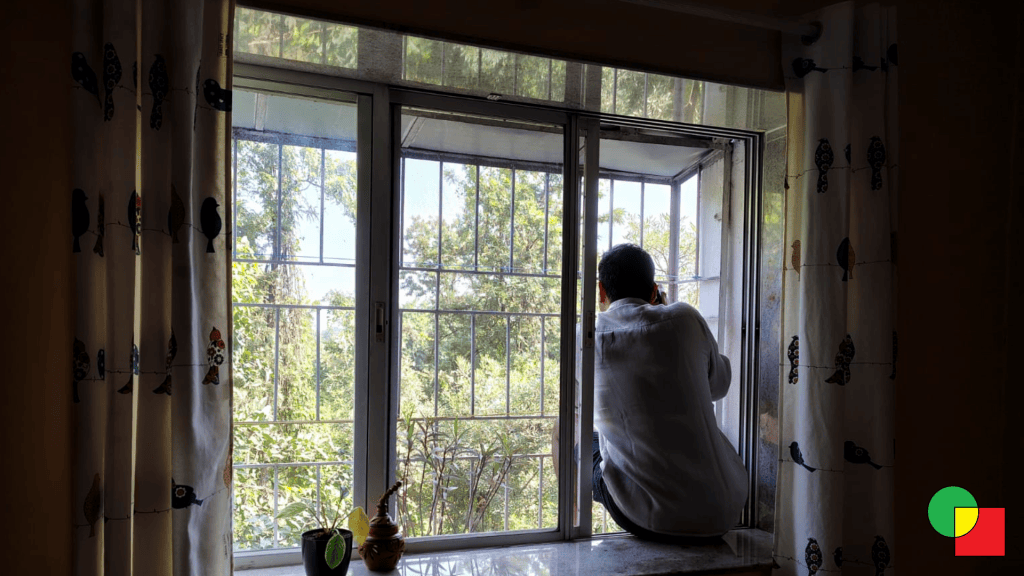
    A person sitting in the window and photographing the birds. The window opens to a lush green trees.
    Our private bird-watching deck: my hobby for a few years was to simply sit there, observe, and click a few pics.
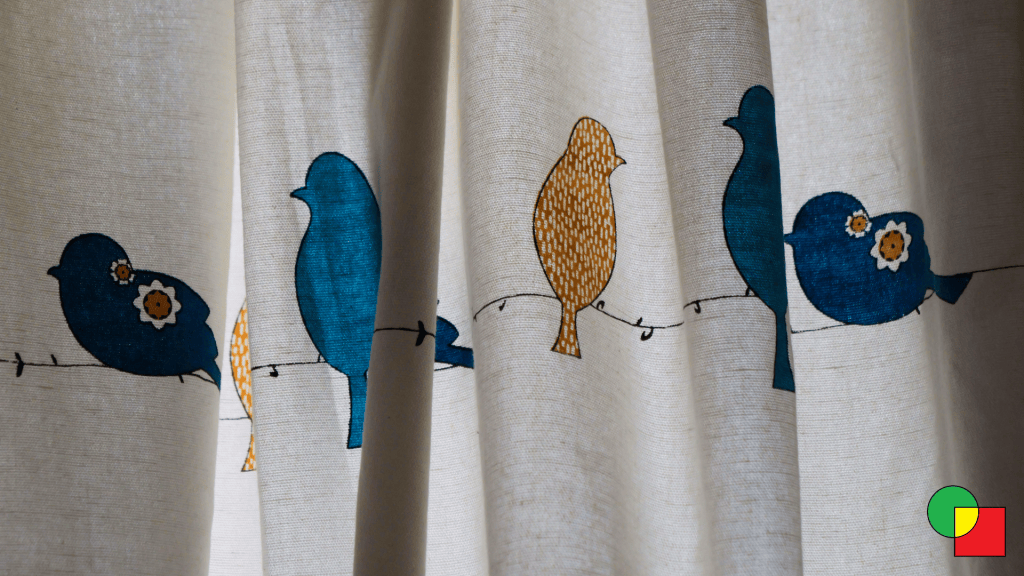
    Bird-patterned curtain covering a window.
    Even before moving here, we had a curtain full of birds. It seems custom-made for this window.

    Two trees, a whole world

    In this blog, I want to introduce you to my neighbours.

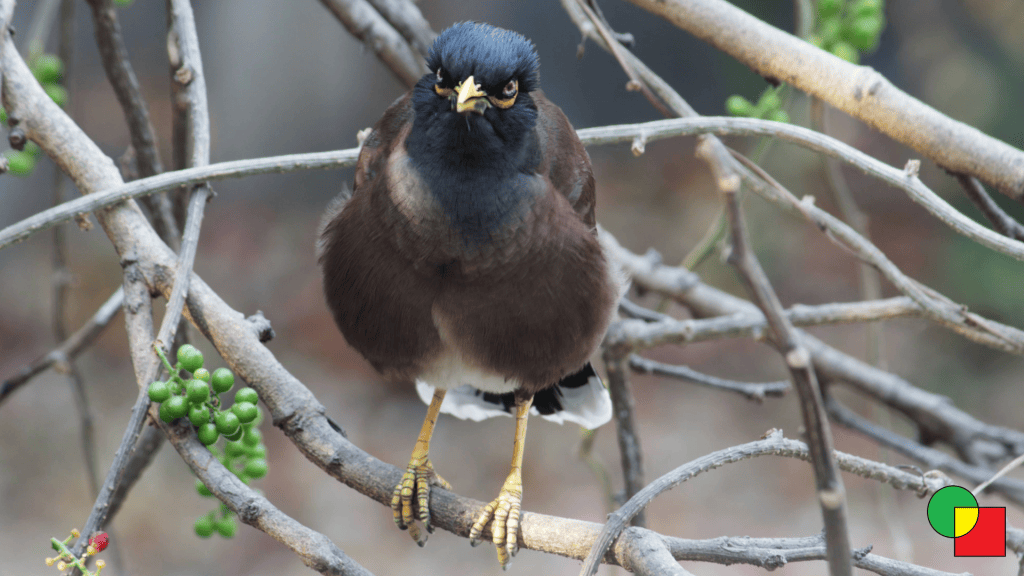
    Just two trees, but together they held a whole world. Over those months I saw over 25+ species of birds. There were many individuals, couples and groups. The main residents were Koels, Parrots, Hornbills, Sunbirds, Mynas, Bulbuls and many occasional visitors.

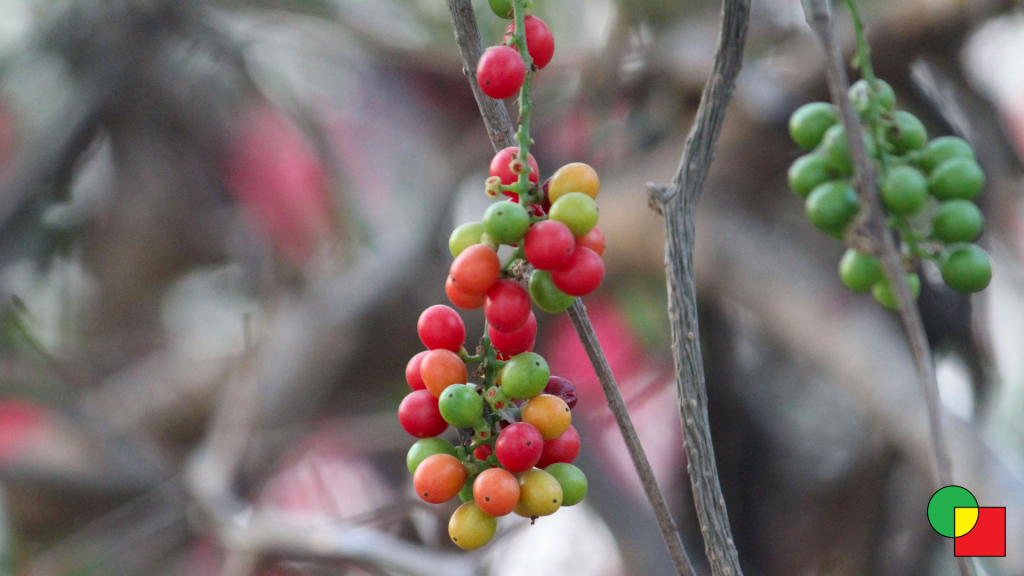
    1. The berries tree: The one on the left was a laburnum, which blooms in April–May, but the highlight was the berry-bearing creeper on it.
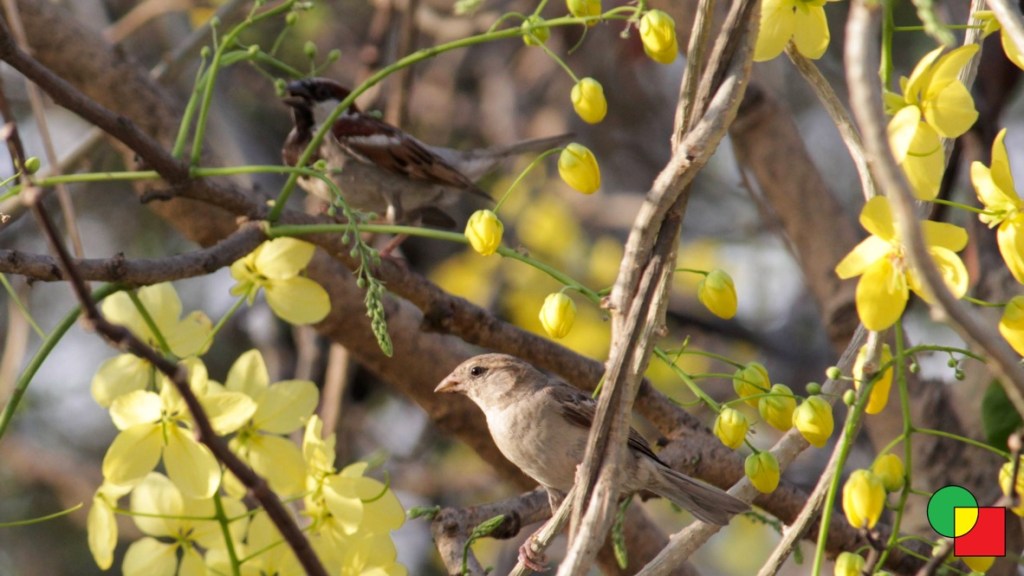
    Laburnum tree with yellow flowers. Also  a male and female sparrow is present.
    This laburnum (Kani Konna) is holding on the creepers. A male and a female sparrow have stopped by.
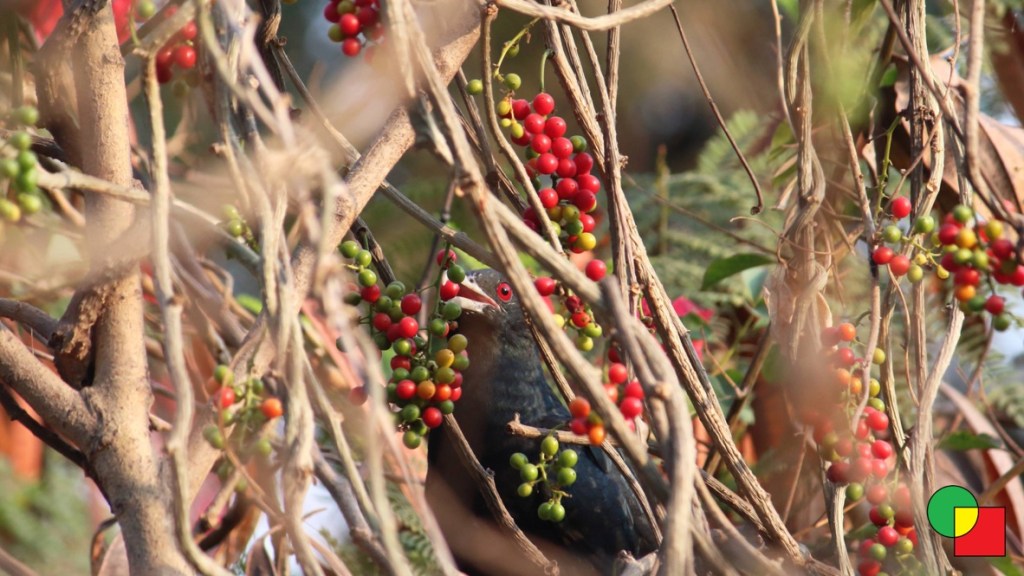
    Berries in different colours and stages of ripeness attracting birds.
    Berries of different colours, depending on how ripe they are. The birds queue up here for them.

    2. The yellow flower tree: This one was a silver trumpet tree (Tabebuia). It turned fully yellow in its season and stayed green for the rest of the time.
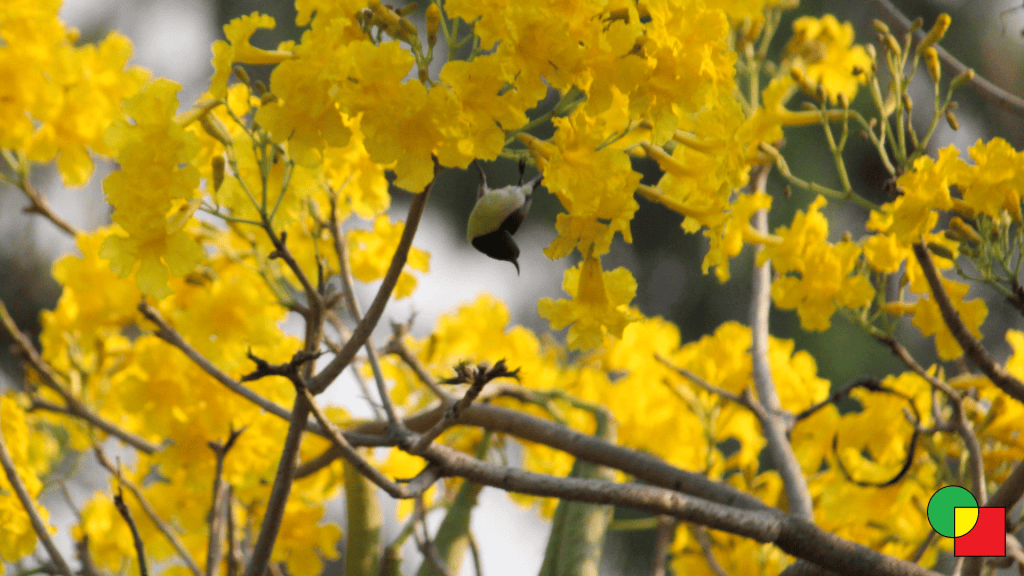
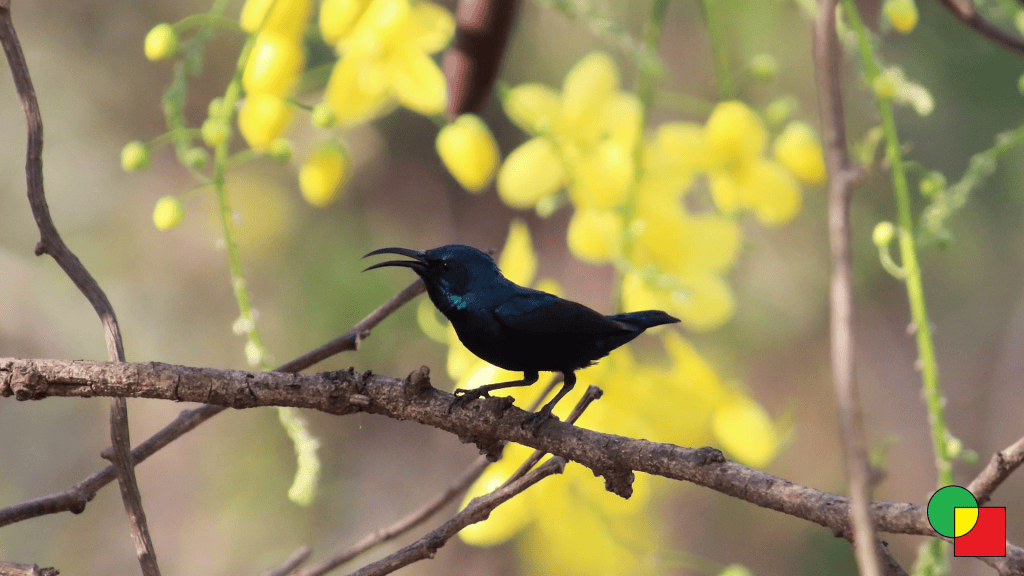
    Sunbird perched among the yellow flowers of a silver trumpet tree.
    Another sunbird, confused about where to start, surrounded by the yellow flowers of the silver trumpet tree.

    I often wondered how they kept track of time. Their breakfast and dinner hours were always in sync, day after day.

    Different species ate different food, and came at different times. The trees fed them all. Many came just to sit for a while and then go.

    Fights, but not over food

    They did fight. The koels fought over mates, and a gang of mynas would take on the hornbills. But I hardly ever saw them fight over food. And when a common enemy turned up, it didn’t matter which group or species they belonged to. They all came together to drive it away.

    Koel duel: The two black male koels were fighting, but without much action. It was a staring game. They moved closer and closer, till one backed away and left the tree.

    So, after all, their life is not that easy. To mark a territory, they have to fight. This tree had both the berries and the females, and the territory granted the rights to both.
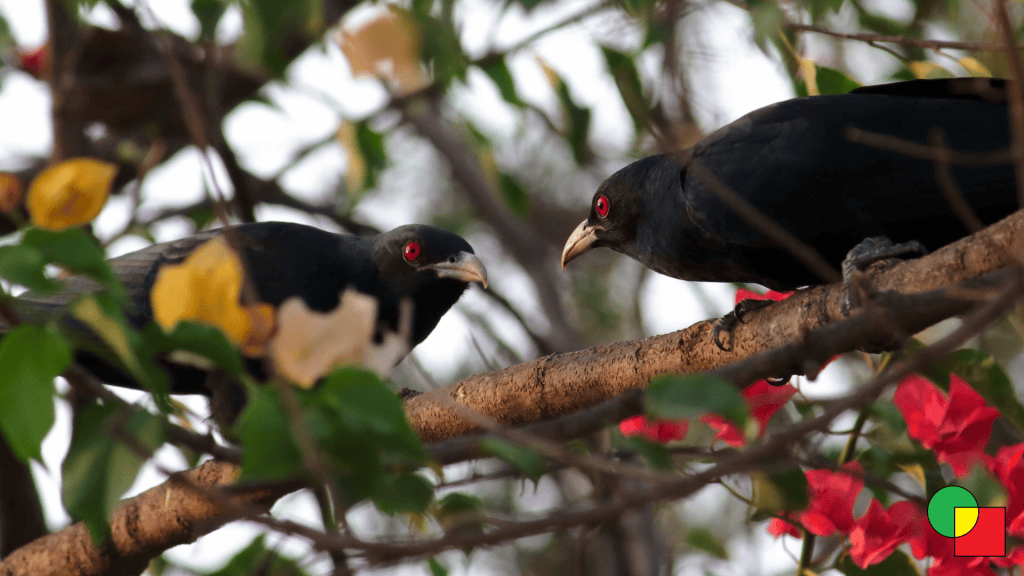
    Two male Koels perched in a tree during a territorial dispute.
    Two male Koels fought for over an hour to get the rights to the tree. Guess who won ?

    Snake alert : One afternoon, I was suddenly woken up by the loud noise of the small sparrow group and the parrots. I went to the window to see what the matter was. I saw the parrots diving at the building’s wall, turn by turn. After a while I sensed something was wrong, and on going down, I found it was a snake trying to crawl up the building. I saw a team up of different species of birds for the first time.
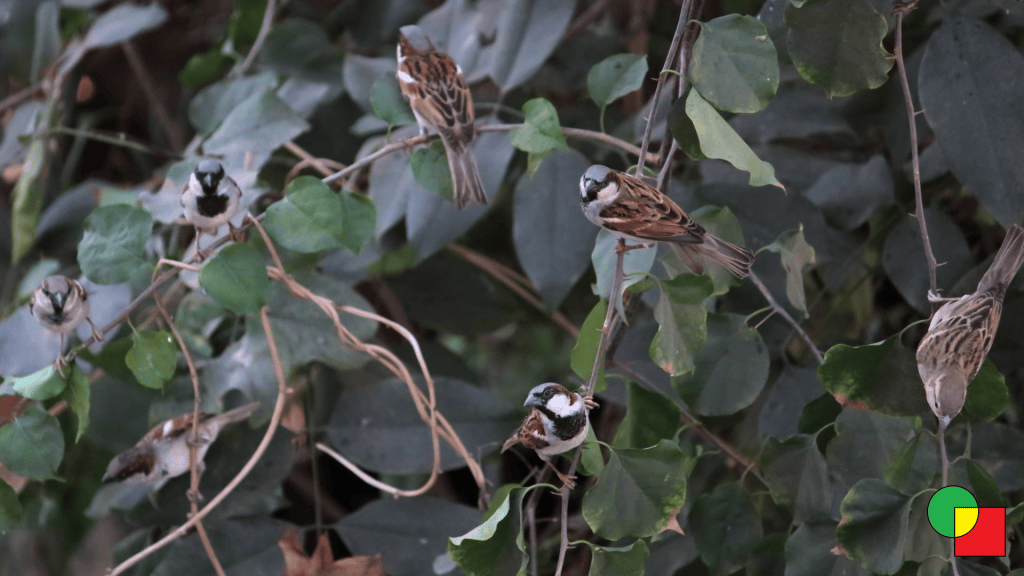
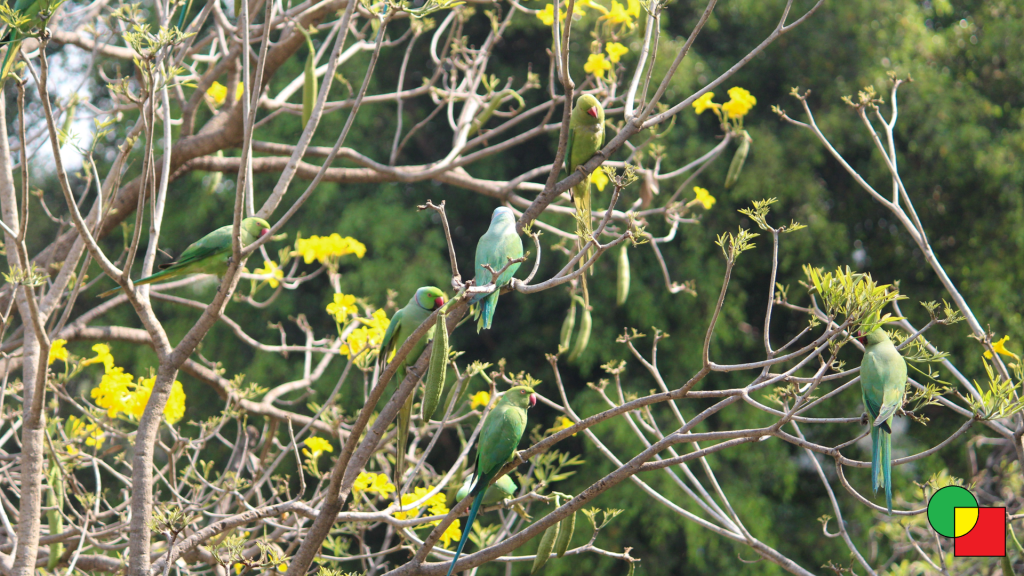
    Sparrows gathered in a tree as parrots join them to mob a snake.
    All the sparrows gathered, calling at the top of their voices, and the flock of parrots joined in to attack.
    A group of parrots perched together in a tree.
    Parrot Gang

    Through the seasons

    I was lucky to watch them through winter, spring, summer and monsoon. The trees changed with every season, and so did the way the birds used them: for food, for shade from the summer heat, for hiding. Most people walking past would never notice that such a world exists right next to them.
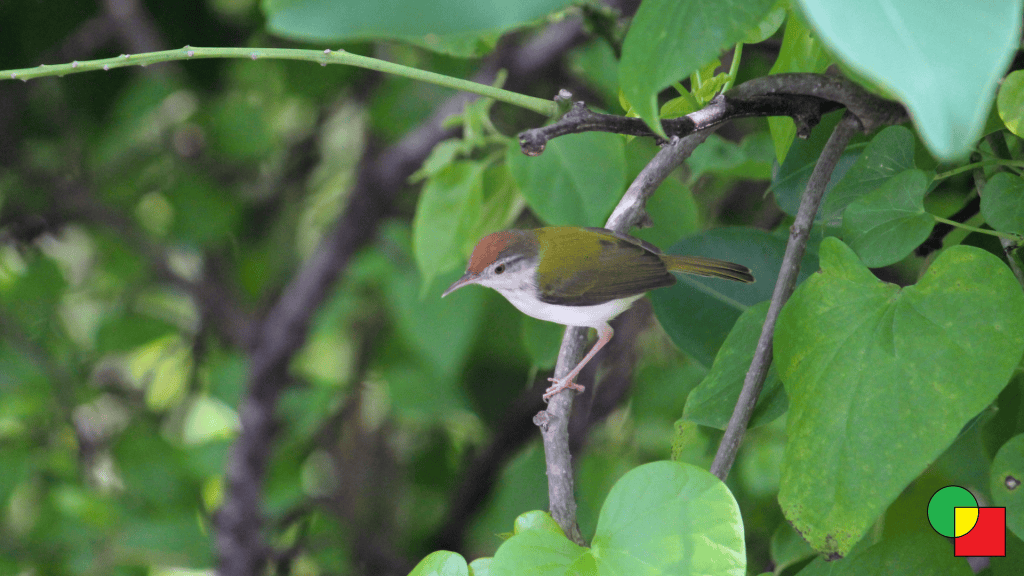
    Common tailorbird against a lush green monsoon backdrop.
    A common tailorbird against the green backdrop of the monsoon
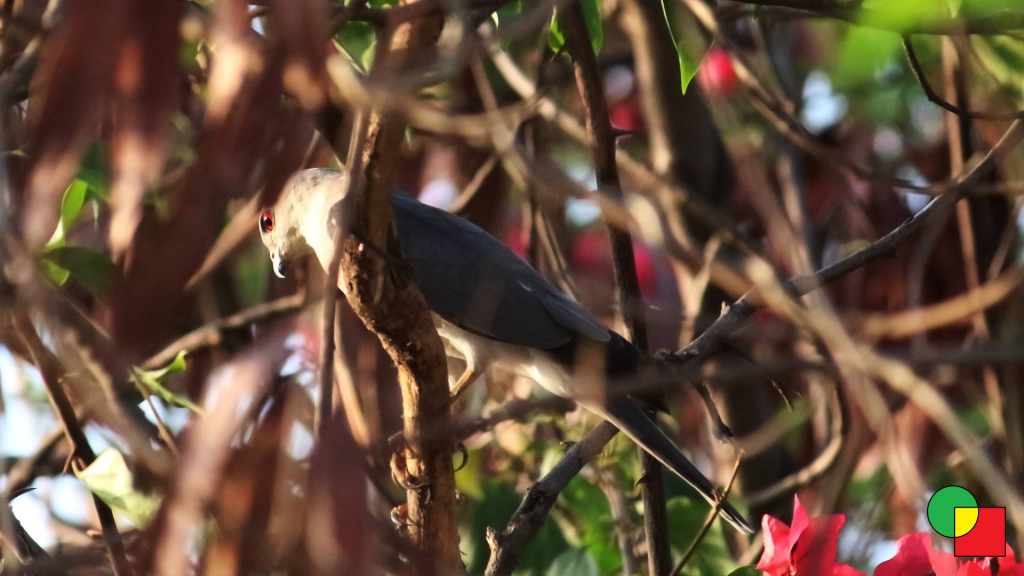
    Shikra perched on a branch.
    An occasional visitor : a shikra in the summer.
    Sunbird resting near yellow laburnum blossoms.
    The laburnum blossom in the background, and a sunbird resting.
    Male koel surrounded by berries.
    A male koel surrounded by the berries.
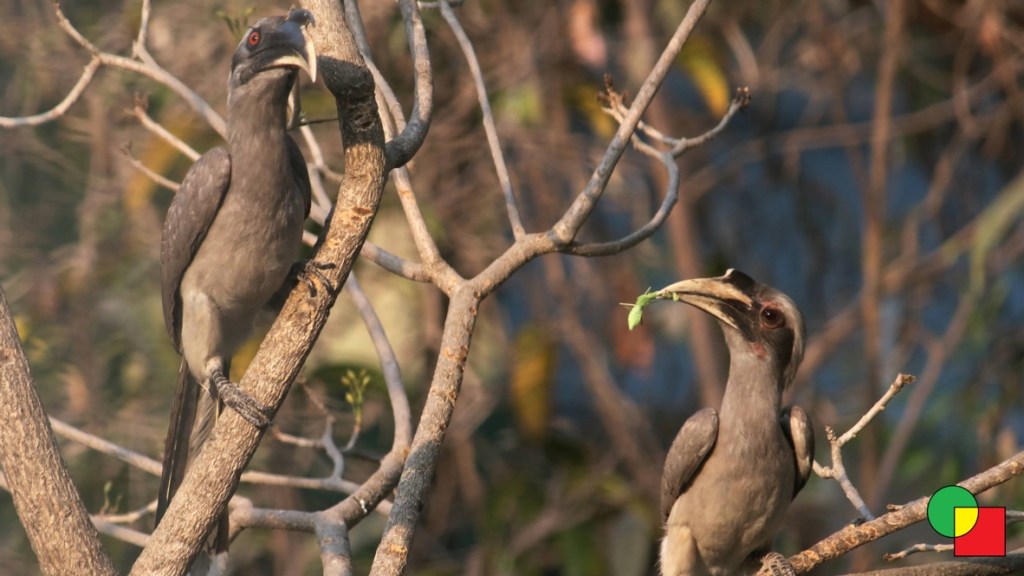
    Grey hornbill couple with a catch.
    The Indian grey hornbill couple with an insect catch in the winter.
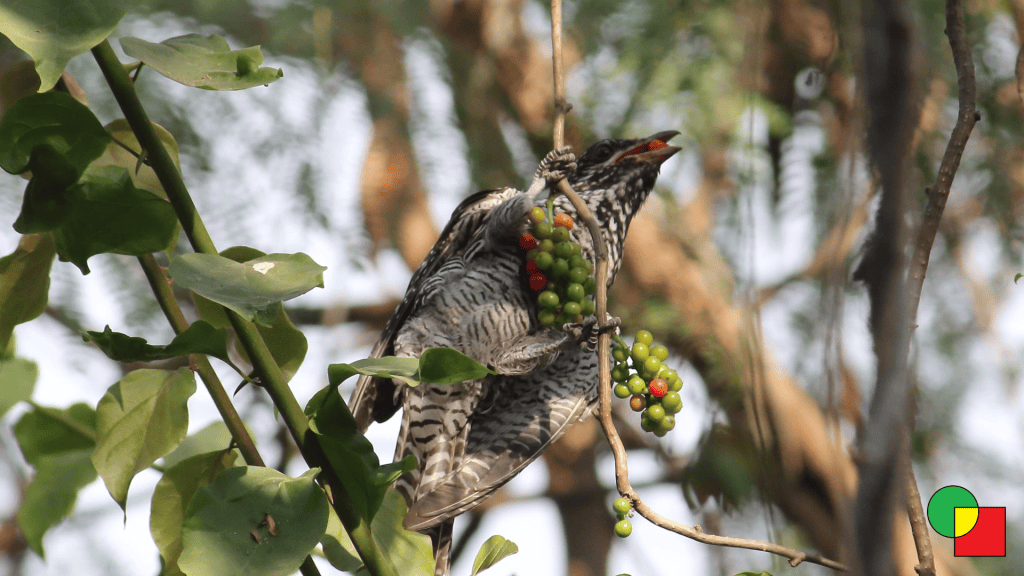
    Female koel holding a red berry in her beak
    A female Koel holding a red berry in her beak.

    All good things don’t last

    We have moved out of that flat recently. The window belongs to someone else now. Also in this monsoon, strong winds and the load of the creepers broke a big branch of the laburnum tree, and it fell. After that, fewer birds came.

    But those windows and what I experienced, I will cherish for a long time. I hope these pictures do the same for you.
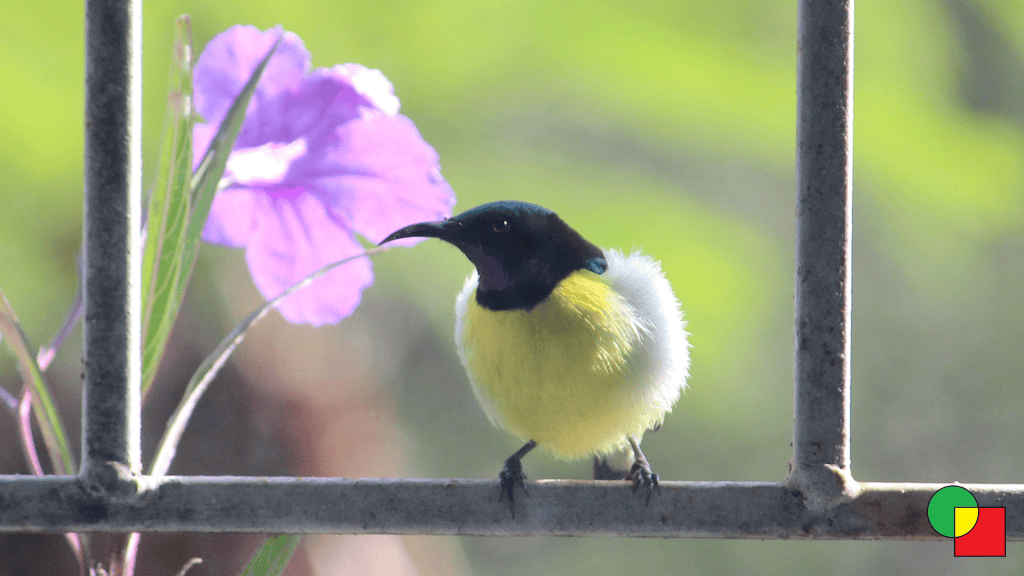
    A sunbird visiting us outside the window for one last time.
    A final adieu : A sunbird visiting us outside the window for one last time.

    The trees by the river

    A few months back people in Pune were protesting the cutting of trees along the Mula-Mutha riverbanks for the Riverfront Development project. Earlier, thousands of citizens hugged riverside trees in a Chipko-style protest. In May 2026, a public hearing in Aundh saw strong opposition to a proposal to fell trees along the Mula at Balewadi.

    For many, this riverbank is like a devrai, a sacred grove, worth protecting so the next generation can see it too.

    My window showed me how much life just two small trees can hold. Imagine what a whole riverbank holds.
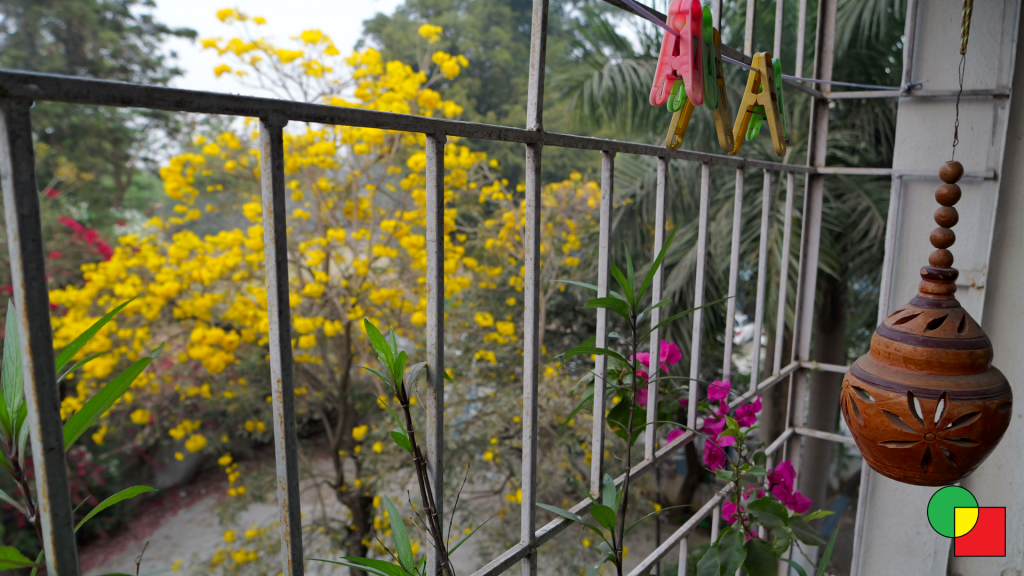
    A window to remember

    Which birds visit the trees near your home? Tell me who your neighbours are.
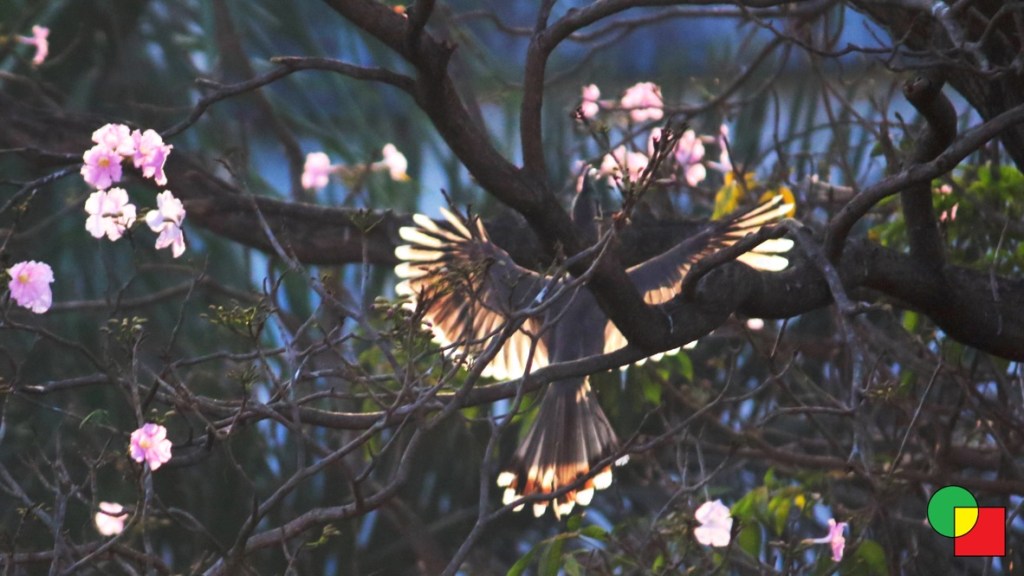
    Bye Bye … from an Indian grey hornbill

    For more stories, images and videos, visit my Instagram.

  • Feathered Friends: From Childhood Curiosity to Balcony Sanctuary

    Feathered Friends: From Childhood Curiosity to Balcony Sanctuary

    As children, many of us imagined what it would be like to fly. “What if I could fly?” we wondered. I know I did. Even now, I am still curious. Why, in this vast world, are they the only ones who can truly take to the skies?

    Early Childhood memories

    A beautiful green patch of Kottayi

    My childhood was in a small village in Palakkad called “Kottayi”. I consider my self lucky to be born in this small beautiful patch of the western ghats of India.

    As a millennial kid, my world wasn’t dominated by screens. TV had only a handful of channels, mostly broadcasting news or other dull programs. Mobile phones were unheard of, and distractions like Instagram or YouTube weren’t a part of life. It was just me, my curiosity, and the unfiltered beauty of the world around me.

    I still have clear memories of me looking at butterflies, birds, ants, insects, leaves, and fruits around me. Our home was indeed surrounded by a diverse set of trees and plants. And that was indeed a world in itself, offering endless wonders to explore and admire.

    A thought : How much can you go back into memories ? What’s your oldest memory ? Is it your mom or dad ?

    School Library

    I used to get up early and have stroll around the thodi (backyard) and “see” many interesting things, be it the birds or new flowers in the golden hour before I get ready for the school bus.

    And if I find a new bird which I don’t know, I clearly remember the excitement I had. I go directly to the library, get books on birds, one was Salim Ali’s The Book of Indian Birds.

    But my excitement would quickly turn bittersweet—discovering that the bird was already listed, shattering my dreams of finding a new species!

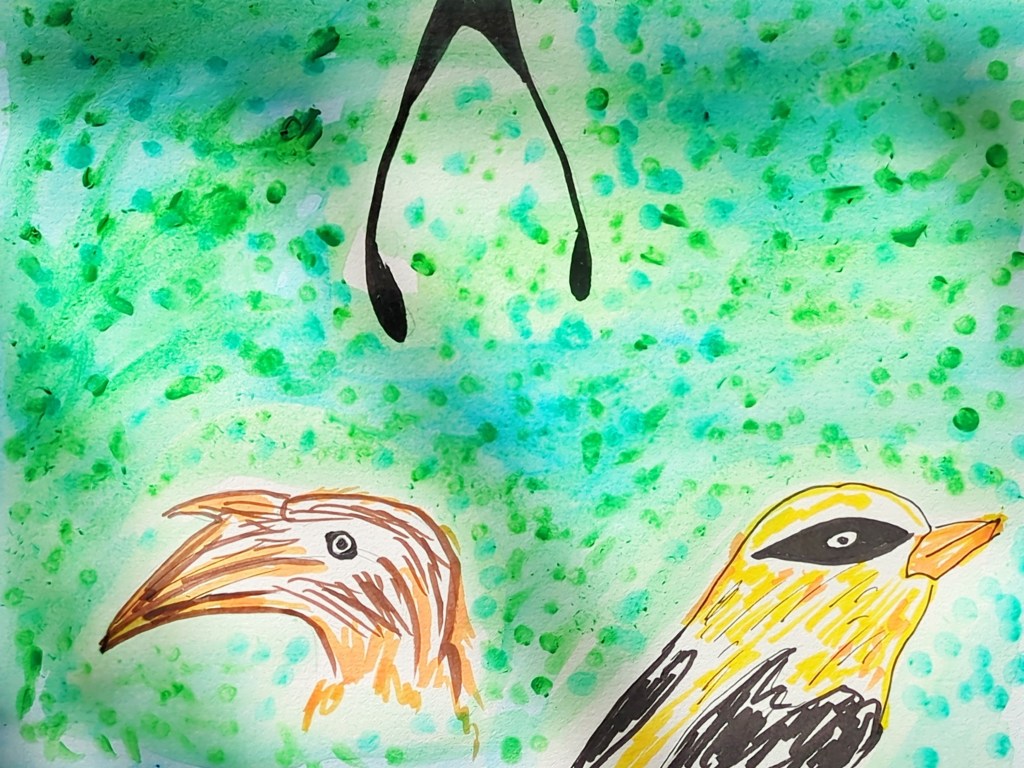
    Looking back, I still remember the excitement of my early “discoveries”—the Greater Racket-tailed Drongo, the Golden Oriole, and the Hornbill. I didn’t had a camera at that time, and all these are the pure memories I still carry.

    From the memories

    From Library Books to Google Lens

    Fast forward to today, We have phone camera’s with zoom which can challenge even a DSLR. Taking a picture, and then asking Google Search, Google Lens, and ChatGPT can do instant identification. You can get the bird’s name, its habitat, population details, and even similar species—all in a matter of seconds.

    Projects like ebird.org are indeed a blessing for bird lovers. You can access a wealth of information. You can also contribute by adding your own sightings. This helps build a global bird watching community. It’s amazing how technology has transformed the way we connect with nature!

    Bird Watching – At bird-eye level

    At the bird’s level

    I recently moved to a new place in Pune. What truly captivated me was the view of the trees and birds outside my large windows. As a child, I always dreamed of being at the level of the birds. However, that was something I could never quite experience.

    In today’s digital age, where bird photos are available in plenty, why bother taking more with my basic camera? Apart from the probability of a “new discovery” (pun intended), what I truly enjoy is the chance to observe them up close. Through my lens, I can watch their every move—what they eat, how they interact, and whether they take a mid-afternoon nap.

    I still find myself wondering about the simple mysteries of their lives: Where do they sleep at night? What do they communicate with each other? And why do they travel so far, even when they already know where the food is? Do they fight with other species ?

    Next Generation

    I wonder if today’s children still share the same curiosity about birds that we once did. Do they experience the same sense of wonder and joy that our generation had, or has the fast-paced digital world overshadowed the simple pleasures of observing nature up close?

    This makes me appreciate the beauty of those childhood moments even more.

    View from my window