
In the last blog (Part 1), I left with a trail of questions. Some of them I can answer now. Some I still can’t, and I am at peace with that.
Is there a connection between living beings and the universe, and what if the temple is a medium for that ?
The tuning fork analogy
I want to start with the symbolism of a tuning fork. Here is the link: Tuning fork symbolism
The video explains that there are two tuning forks with the same frequency. Hit one, and the second one is ringing. Nobody touched it. The sound travelled through the air and made it vibrate. That’s resonance.
Now think about the sreekovil/Sanctum (the central part of a temple). It’s a small stone room with a deity figure made of a particular stone or a certain amalgamation of metals.
Now mapping this as a metaphor, the temple is the box, the deity is one fork, and we are the other. Locally it’s said that be in the temple for some time, like doing a circle (Pradakshinam) around the sanctum or to sit there for a while. Is that to tune us in ? Does it shift the mind in to an alpha-wave state? I don’t see any proof or evidence for this but will be interesting to explore.
Looking back
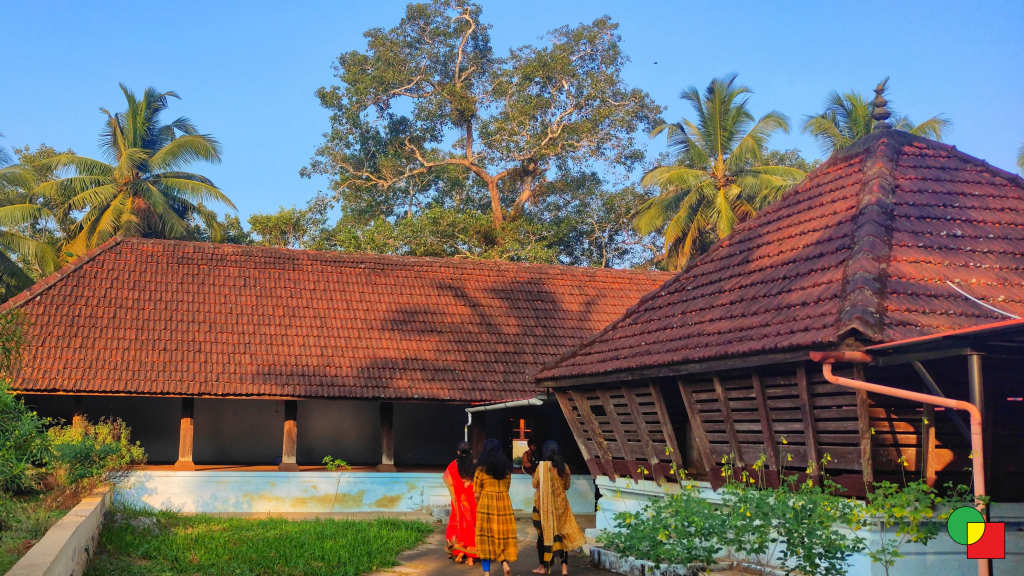
Growing up in Kottayi, I noticed that the temples around me were similar, and yet different. The sanctums of the Shiva temples were circular, the Vishnu temples had tiers, and some were simply square. I always wondered why.
Studies, work and travel took me across India, and the question kept growing: why were temples built so differently? Was there a scientific reason, or a divine one?
I have always wondered how it’s tied to astronomy. At Padmanabhaswamy temple, on the days of the equinox, the setting sun passes through the gopuram’s windows one by one. And of course sun temples like Modhera (Gujarat), Konark (Odissa) are known for their alignment with Sun’s movement.
Temples of the world
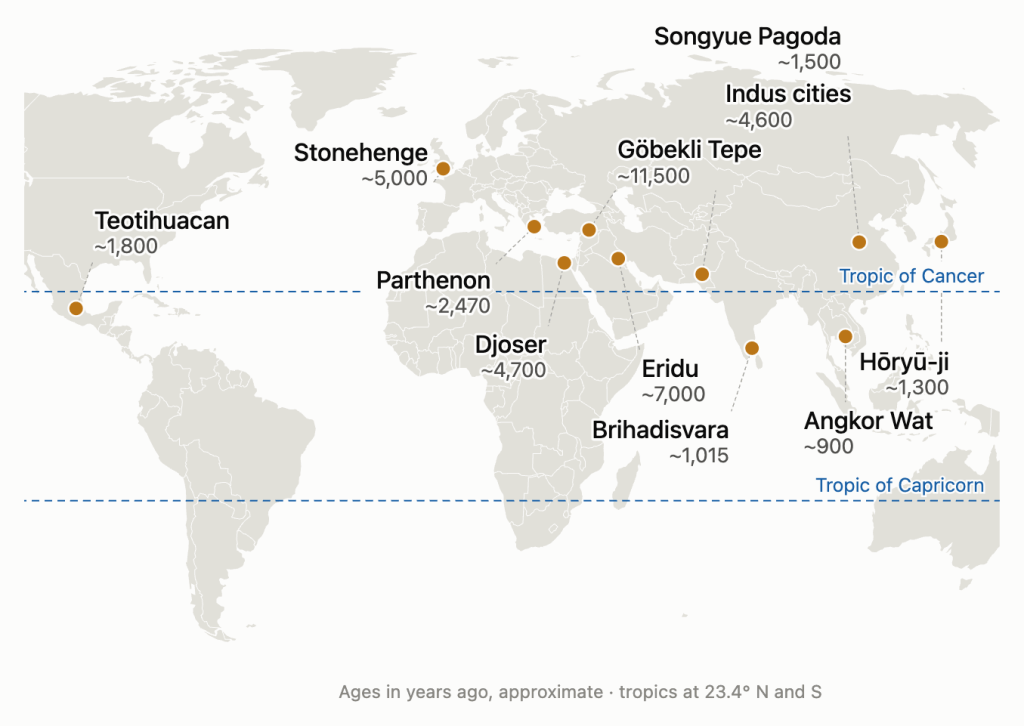
Even though I didn’t get any opportunity to see the old temples of the world, I took the help of online resources to have a peek. And I realised that Indian temples are not the oldest, as per the scientific community! It came as a surprise.
Even though the Ramayana and Mahabharata are believed to be much older, the accepted evidence is not there yet. The Indian scriptures indicate a cycle to the existence of the world/universe, and it gets destroyed and reborn again.
The earlier mud, brick or wooden elements of the earlier temples/ ceremonial places might have thinned out over the cycles of time. Stone survives best; brick survives as ruins; wood survives only rarely, by being rebuilt.
What I can see is that Göbekli Tepe in Turkey stands out as the oldest surviving ceremonial place. And around the Middle East there is evidence of similar activities. Interestingly in the Indus Valley, there was no clear evidence of temples, but a well-built civilisation.
Also it’s interesting to see the geographic location of the sites along a specific band of the Tropic of Cancer.
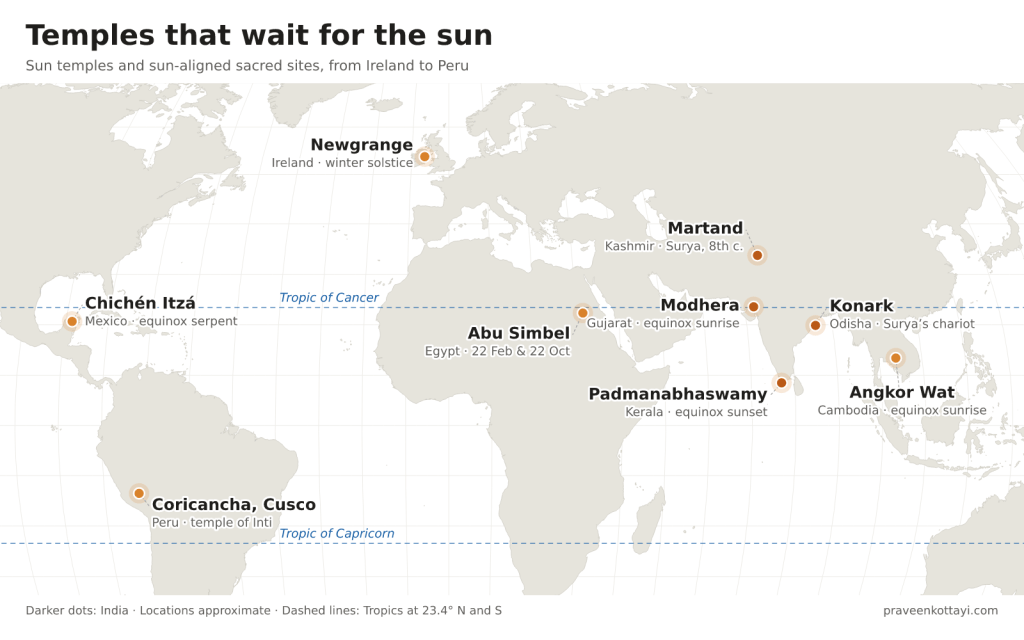
The sun has been at the heart of temple-building everywhere. In India, Konark, Modhera and Martand in Kashmir were built for Surya (sun), and Modhera’s sanctum catches the first rays of the equinox sunrise. In Egypt, the rising sun lights the inner sanctuary of Abu Simbel twice a year, and in Cambodia it rises right over Angkor Wat’s central tower on the equinox. At Chichén Itzá in Mexico, equinox light forms a serpent on the pyramid’s steps, and the Inca built their holiest temple in Cusco for Inti, the sun god. Different lands, different gods, but the same intention.
The temples of India – Timelines
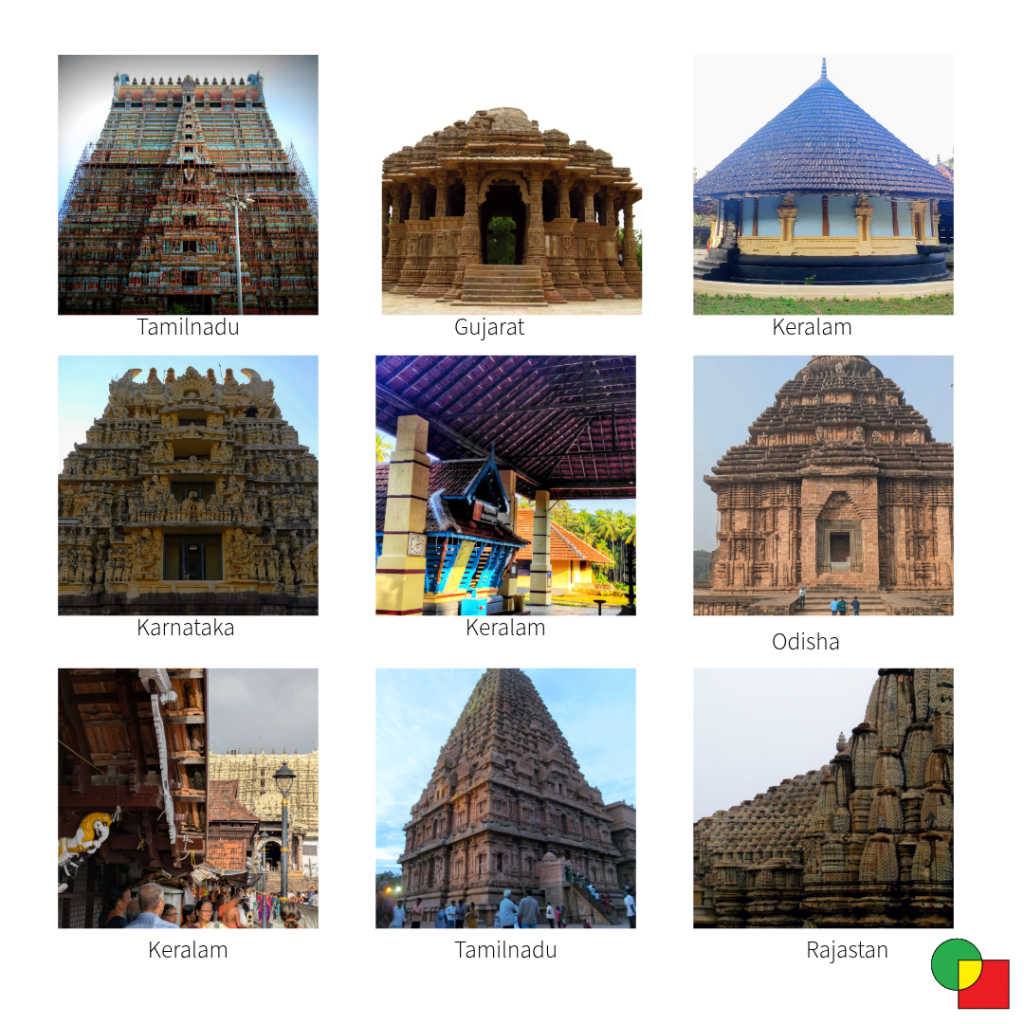
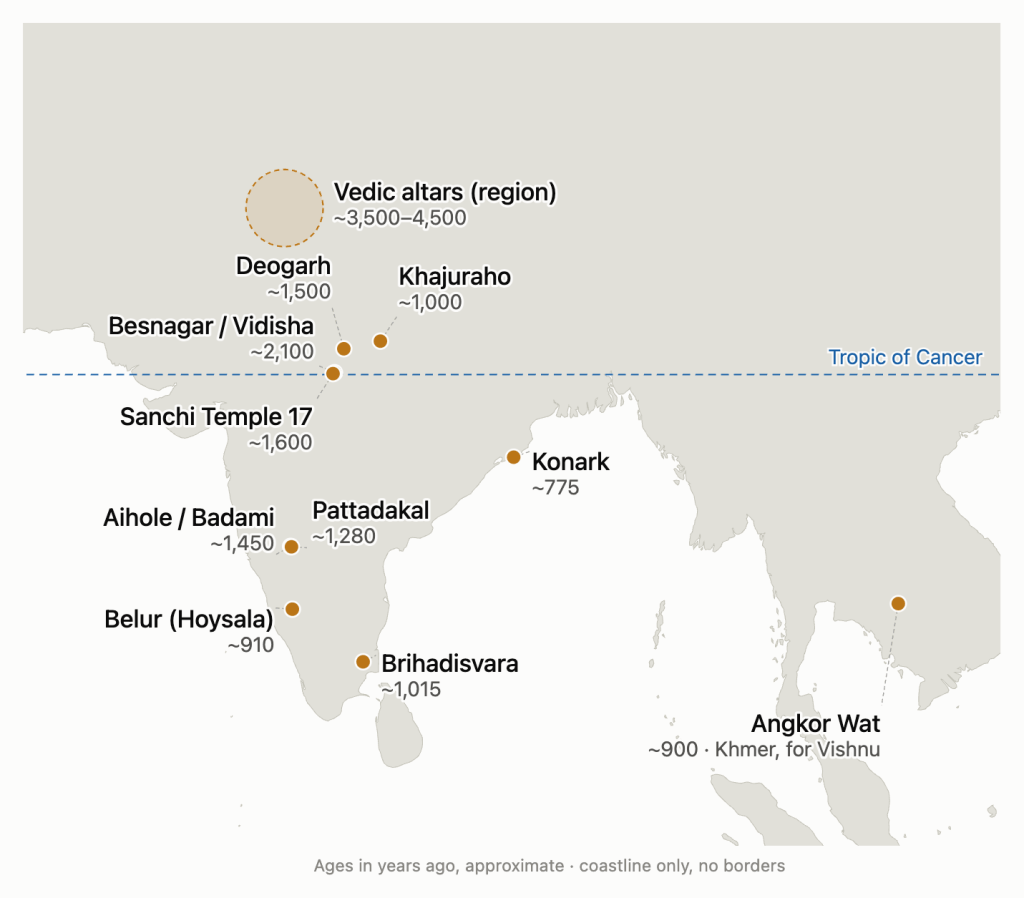
And I assume the timeline indicates that the growing influence of Buddhist temples could be a political reason for the accelerated development of these temples.
The origin of today’s prominent Hindu temples points back about ~1500 years. The area of Aihole /Badami/Pattadakal carries the remains of the historical lab setup for Indian temples. But interestingly, at Aihole, Hindu, Jain and Buddhist temples stand side by side.
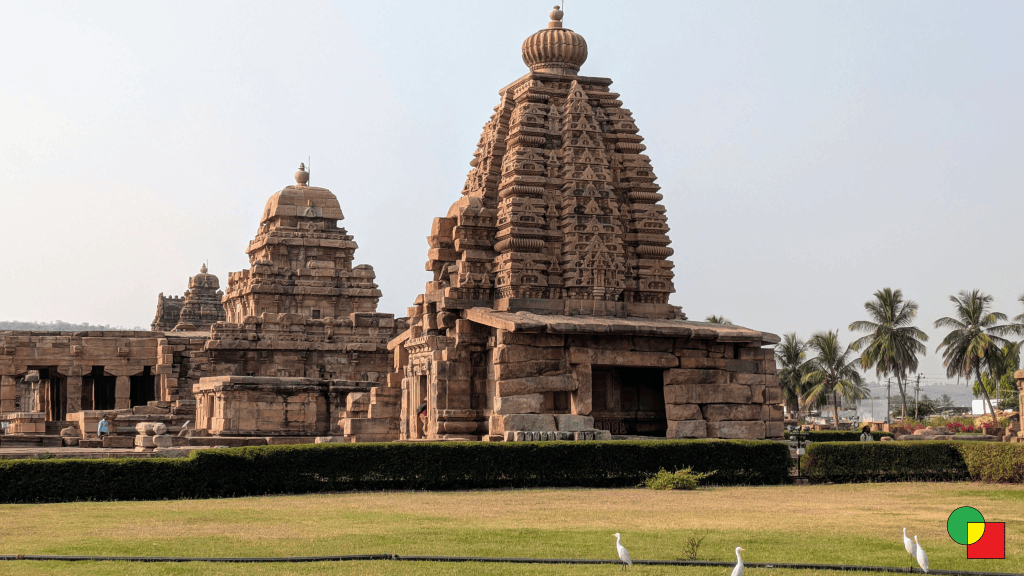
The Kerala/coastal Karnataka temples seem to have a different origin. Even though the geometry of the complex is similar, the long spell of rainy seasons might have led to different kind of temples with sloped roofs. It looks very similar to the pagodas found in China, Thailand and Japan.
Temple as an Art gallery
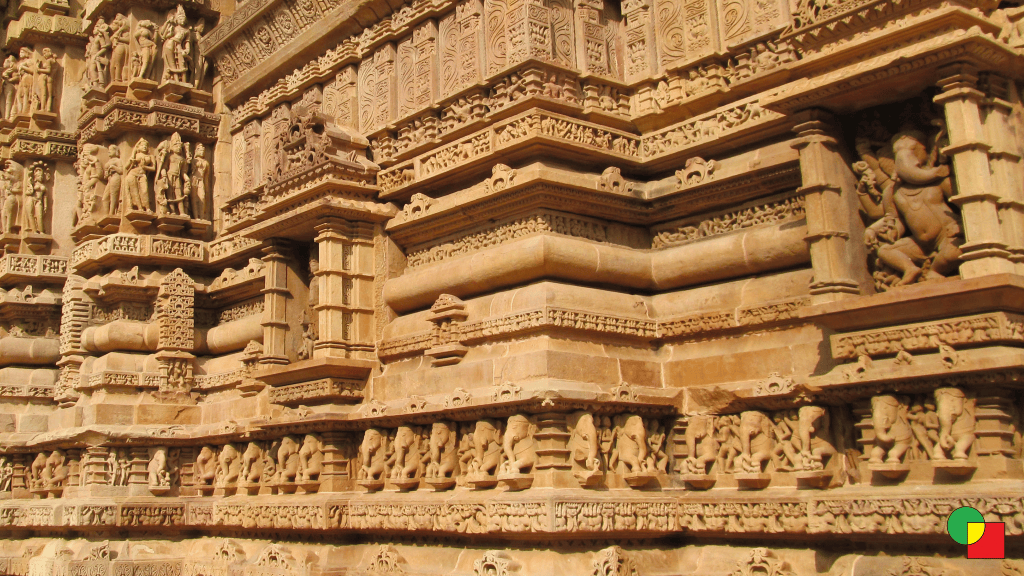
Long before social media or exhibitions, the temple was where people saw art. The walls told the Ramayana and the Mahabharata in stone, the dancers were frozen mid-step, and gods and animals filled every pillar. For people who could not read, the temple may also have been a school, a gallery and a library at once.
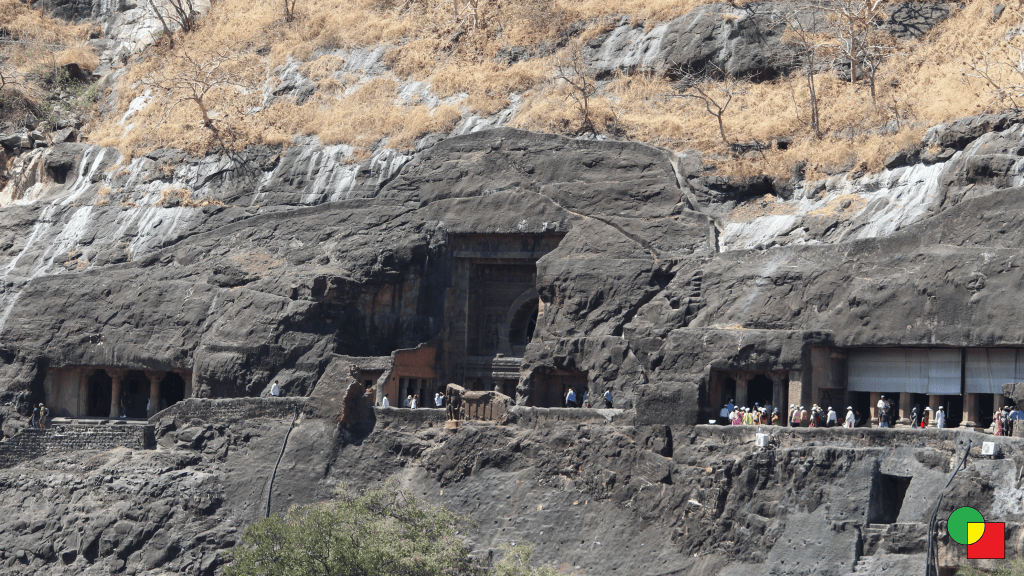
I still wonder at the skill of the people who carved an entire temple out of a hill at Ellora, Maharashtra. The Kailasa temple was cut from the top down out of a single rock. There was no scaffolding to climb and no stone to add back if someone made a mistake.
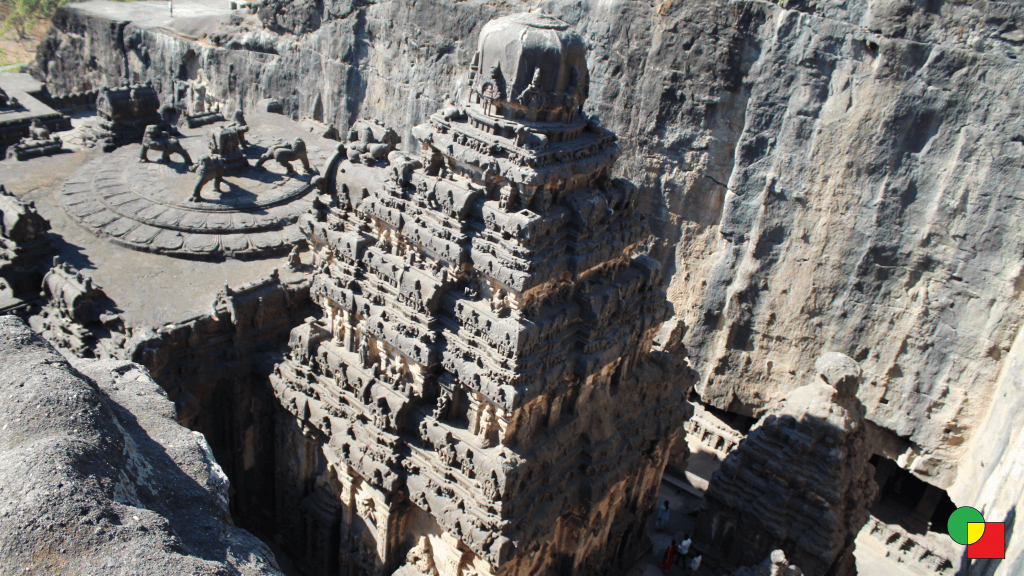
This was no accident. Pallava carvers in Tamil Nadu had already cut whole temples from single granite rocks at Mamallapuram, about 1,350 years ago. The Virupaksha temple at Pattadakal followed about 1,280 years ago, and Ellora’s Kailasa, about 1,250 years old, seems to draw on it. Around the same time, the Pandyas began carving Vettuvan Koil at Kalugumalai downward from the top of a hill. They never finished it, so you can still see how the work went: top first.
Temple as an economy
Whether one is connected to the universe or not, a temple holds up a lot of lives. The flower seller, the coconut vendor, the prasadam counter, the lodge, the rickshaw at the gate, the bus, the travel agent, even the airline. A single festival can feed a whole town. Long before the word “tourism,” the temple was already an economy.
Temple as a guide
It was also a map. There are 51 Shakti Peeths, 12 Jyotirlingas and the 4 Dhams, spread from the Himalayas to the southern sea. To visit them, one had to cross the country. Rameshwaram, Puri and Dwaraka stand by the sea. Trimbakeshwar sits near the source of the Godavari. Hampi rests among boulders on the Tungabhadra. Old temples chose rivers, hilltops, forests and shores. And the sacred groves, the kavus, are temples that were never built at all, only protected.
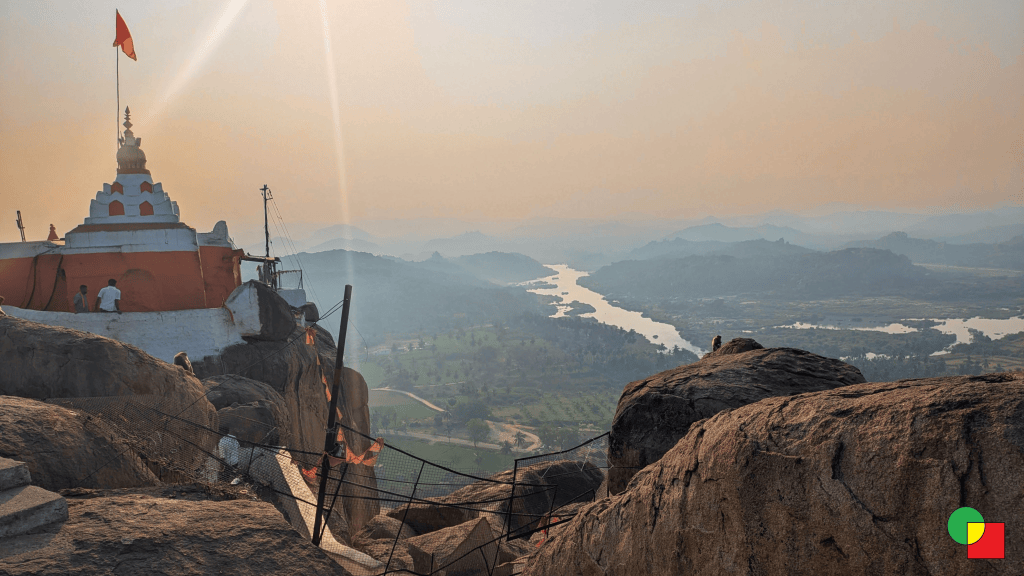
At Hampi, I saw a small Hanuman temple with nothing grand about it. No rules of temple-making made it special. It was the location and the view. Karnataka says it as the birthplace of Hanuman, and no wonder we can find a lot of monkeys in the region. The stories had a geographic sense.
So for many of us, temples became a way of travelling India: to see its people, geography, history, rivers, sea and architecture. Perhaps that was part of the design too.
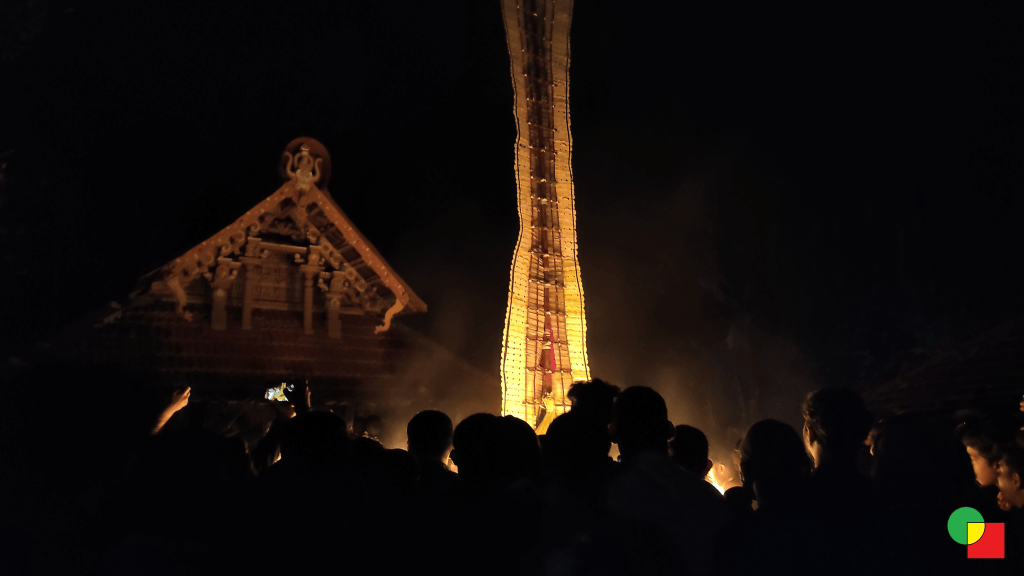
Some temples are not buildings at all. In the kavus of North Malabar, the god comes walking. In Theyyam, after hours of song and make-up, the headdress is placed on the performer, and he is no longer himself; he is the deity. For a night, people from communities once kept outside temple walls become gods, and everyone, bows before them. Across the border in Tulu Nadu, the same idea lives on as Bhoota Kola, the ritual many of us first saw in the movie Kantara. Here the temple is not stone or wood. It is a human being.
The Temple as a Mirror
Geometry of the self, temple and the universe
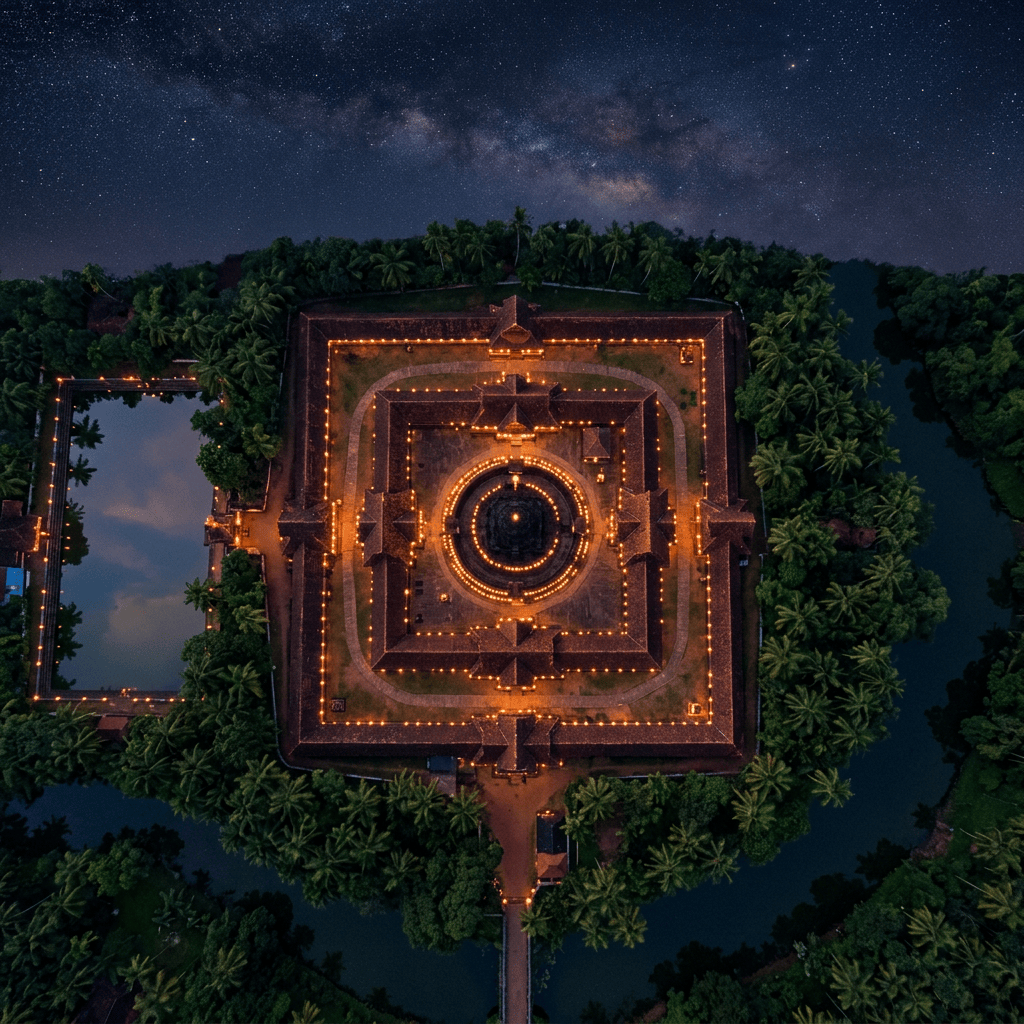
A temple is not just a building but a living body mapped onto a geometric grid. The construction is said to resonate in harmony with the person inside.
Here is my hypothesis, in pictures. Worship began in the open, under the stars, the sun, fire, water and forest, and the temple slowly gathered all of them around one sanctum. The plan of that sanctum comes from an old square grid, the Vastu Purusha Mandala, where a cosmic being lies across the site and the deity sits at his centre. North or South, tall tower or sloping roof, the same idea holds: the deity at the centre, rings around it, one axis rising from the idol to the sky, and a path that asks you to walk around it and then sit still.
If the universe, the temple and the self share one pattern, then the temple is not only the god’s house. It is a mirror, where one looks outward to turn inward. This is symbolism, not a physics claim.
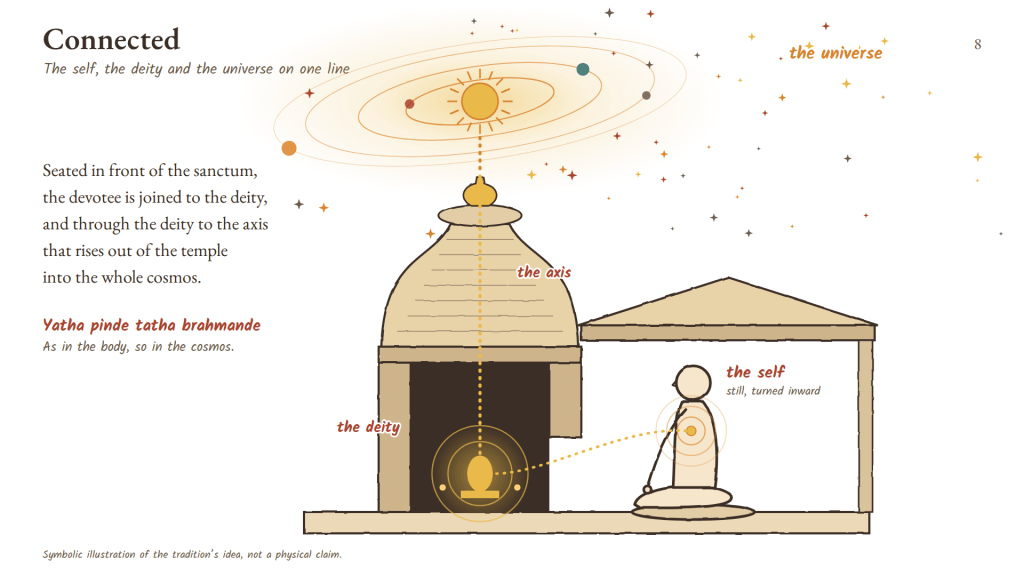
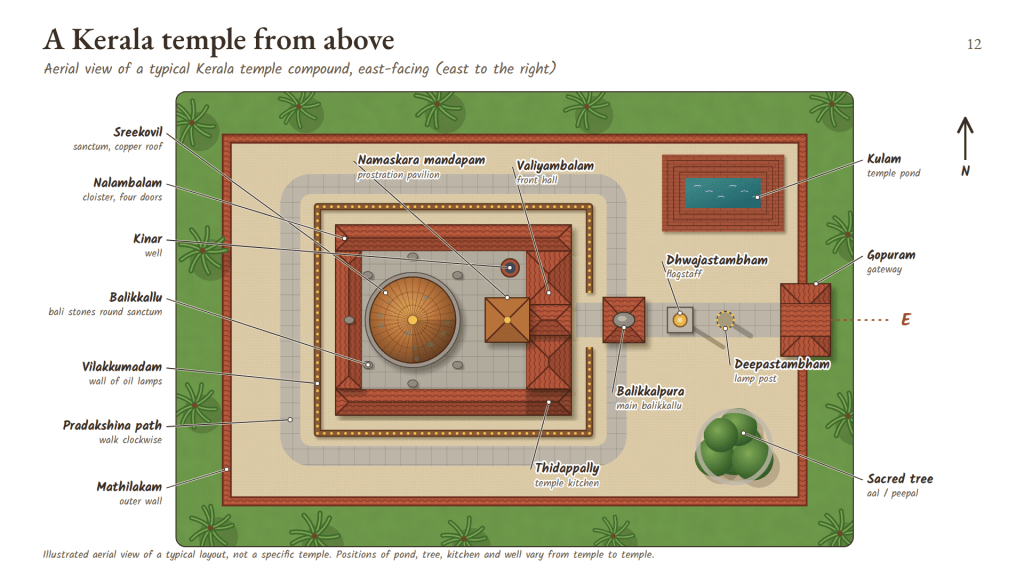
Here it also represents the human laid with feet at Gopuram and head at Sreekovil.
| Temple | Self | Universe |
|---|---|---|
| Gopuram (gateway tower) | Feet: the first step in | The physical world |
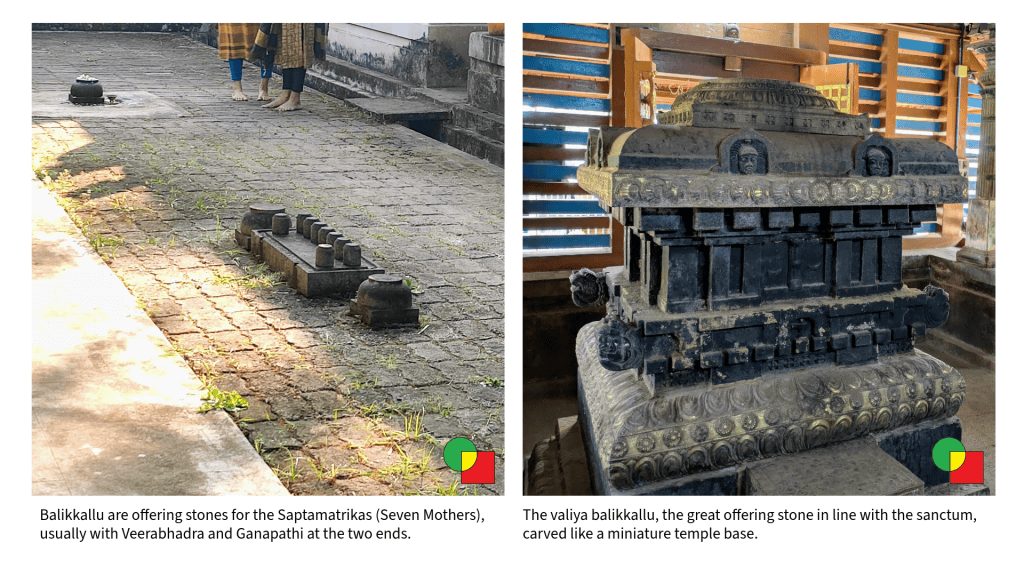
| Balikallu (stone outside the sanctum) | Ego, desire, anger, left behind | What we let go of |
| Sreekovil (shrine) | Heart and chest | Life |
| Garbhagriham (inner sanctum) | Consciousness, the “third eye” | Union: where self and universe meet |
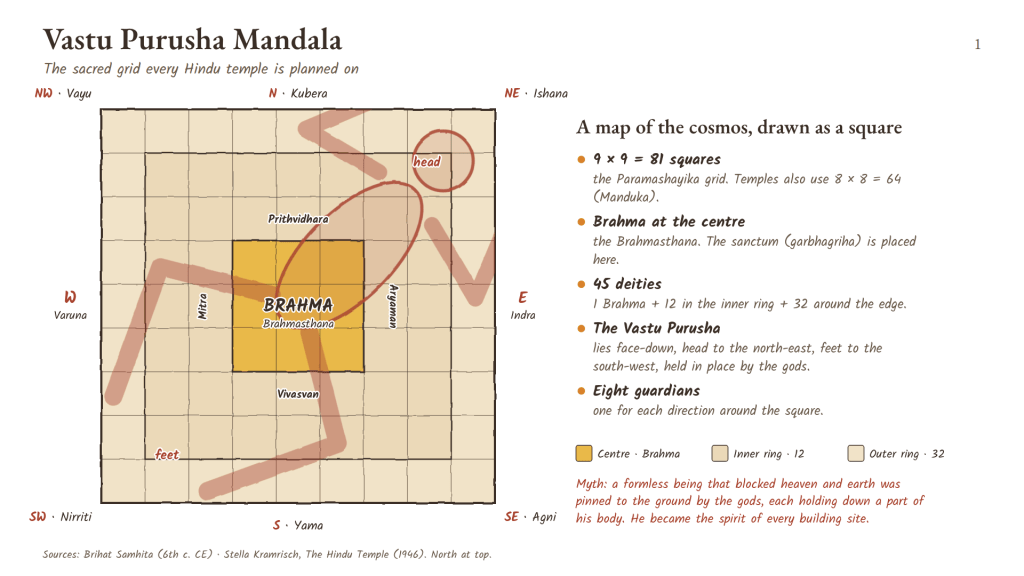
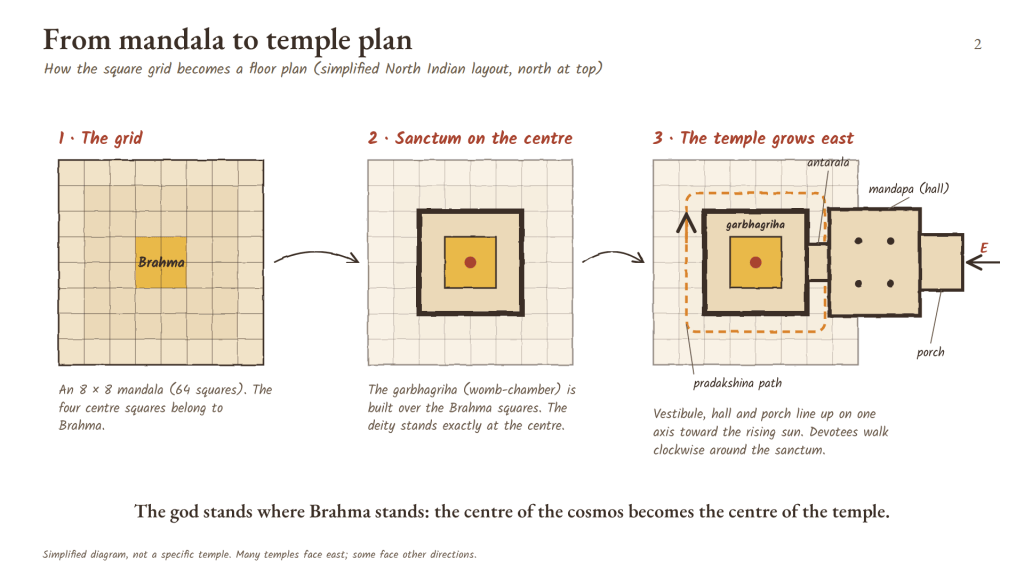
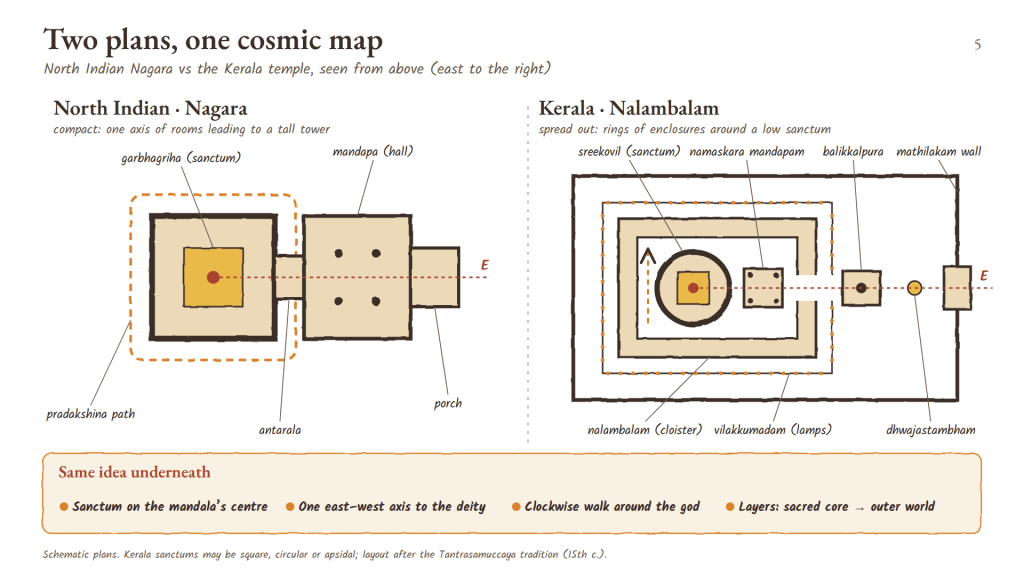
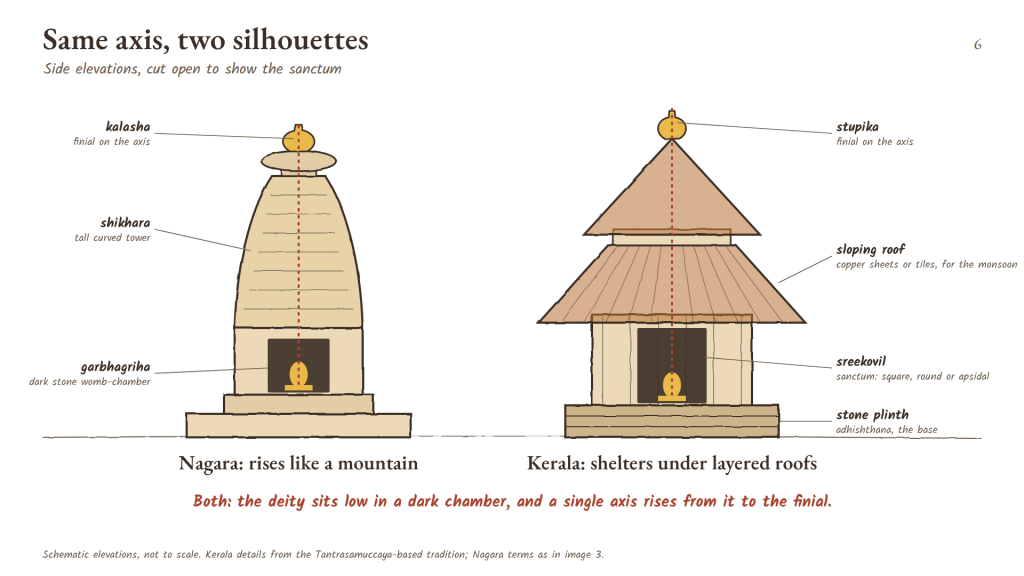
In Part 1, I asked whether the Meru and the Sri Chakra were a code linking the earth and the stars. I went looking for the Sri Chakra in the temple’s design, and found the Vastu grid instead. Temples are laid out on the mandala. The Sri Chakra is a separate diagram of worship, and the Meru is its three-dimensional form. Some temples keep one before the deity, but it is not the building’s blueprint. And some say it’s related to the Vastu grid where both the central points align.
Temples of the future
Today, we carry the whole world in our pocket. Notifications, news and noise follow us everywhere. Maybe that is why the temple still works, even for those who never ask why. The thick walls, a single lamp, the smell of camphor, the evening hour: together, they quiet the mind for a while.
Many who go don’t bother whether there is science behind it. They simply come out calmer. I assume temples didn’t exist at the start; they evolved over centuries. If one needs to go inward, one may or may not need a temple. Temple is one medium to pray. But temples were here before us, and they will be here after us. I expected the Sri Chakra and the mandala to be a hidden science. But they turned out to be something more human: a way of making meaning visible.
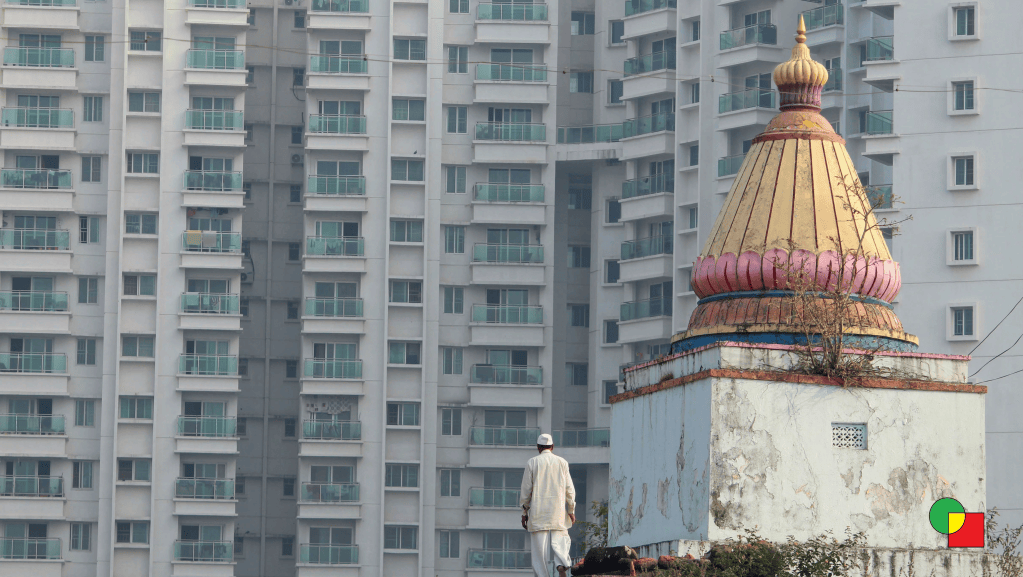
I still have unanswered questions about the temples and rituals. But for someone like my mom, there are no questions. She just believes, in every form, without a WHY in between.
Tat Tvam Asi…
I would be happy to know, if any of the information was new to you. And let me know, if you want to research more on any specific part. This blog was meant to go through my curiosity and thoughts, rather than academic research, but it took me months to put forward what it is today.
And thanks to my friends and family who HAD to visit with me to these places. :D
More reading (If you can take more) :

